Pattern Automation
Root Pattern Automation Enterprise Playbook AI Strategy.md_

AI in business:
without FOMO or panic

Based on analysis of the largest consulting firms, research bodies, and the author’s hands-on experience.

McKinsey — Rewired Gartner — AI Roadmap + TRiSM BCG — Deploy / Reshape / Invent · Pattern Automation Pattern Automation · Toyota 5S with AI, re-invented
88%
“have adopted” AI
~1%
truly mature · without NEURO OS
1/5
reach ROI · without NEURO OS
74%
stuck at scale · without NEURO OS
2-6x
leader vs. laggard gap in TSR (total shareholder return)
Context
88% “have adopted AI.” Only a few see profit.
McKinsey, Gartner, and BCG — three of the largest consultancies — agree on one thing: companies are buying AI tools at scale, but the money is not showing up.

McKinsey studied 200+ transformations — leaders pull ahead of laggards by 2–6× in TSR[?] (total shareholder return). But they rebuilt six chunks of the organization, not just plugged in ChatGPT. Gartner is sharper: 1 in 5 AI projects pays back; only 1 in 50 reaches transformation. BCG: 74% cannot capture value beyond pilots (test launches).

What matters: 70% of the difficulty is people and processes. BCG If you think connecting an API will make money flow — take a breath.

Pattern Automation in practice: with clients we see growth and KPI movement — if not in one department right away, then in another: rollout like a LEGO set, blocks placed in parallel across many departments at once.
88%
“we use AI” McK
74%
stuck at scale BCG
1/50
reach transformation Gar
57%
trust among mature orgs; 14% among immature Gar
10/20/70
algo / tech / people + processes BCG
§
Practice for the owner
Lebedev interview · practical materials from the Pattern Automation team · steps and system prompt
Three frameworks - one meaning

McKinsey · Gartner · BCG - pillars on one screen

McKinsey Rewired

6 blocks · 200+ cases
  • Strategy and roadmap
  • Digital footage
  • OS (agile pods)
  • Tech environment
  • Data architecture
  • Adaptation and scaling

Gartner AI Roadmap

7 workstreams 5 levels
  • AI strategy
  • AI value (use cases)
  • AI organization
  • People and culture
  • Governance (TRiSM)
  • AI engineering
  • Data for AI

BCG D-R-I

5 strategies · 1,250 C-level
  • Deploy: tools (+10–15%)
  • Reshape: workflow (+30–50%)
  • Invent: new business models
  • Rule 10/20/70
  • AI-first operating system
Implementation
Rewired Flowchart · Gartner/BCG Tabs · Practices, Risks, Vocabulary
IMPLEMENTATION
01 block diagram
02 gartner
03 bcg
04 12 practices
05 risks
06 jambs
07 from the trenches
10 dictionary
McKinsey Rewired: 6 blocksMcK

Click on the block. Inside steps + Gartner + BCG.

1
Strategy and roadmap
C-level · domains · KPI contract
Synchronize your top team.A single “digital language”. Let C-level look at what DBS Bank, Freeport, LEGO did - not press releases, but reality.McK
2–3 domains, end-to-end.A domain is an integral piece of a business: for example, “the customer journey from application to payment” or “the production cycle from order to shipment.” End-to-end means from beginning to end, not separate pieces. 80% of successful interventions are when they abandoned a dozen small pilots and focused.McK
Roadmap as a contract.Link to metrics: customer churn, conversion[?](% of those who buy), yield[?](product output). Quick wins 12–18 months, transformation 3–5 years.
20%+ EBIT[?]improvement (EBIT = earnings before interest and taxes) McK
>
Gartner:There is no universal roadmap. Assess maturity based on 7 pillars, choose activities to suit your level.Gar
>
BCG:Three “games” - Deploy (+10–15%), Reshape (+30–50%), Invent (new models). 3–5 functions each.BCG
2
Personnel
digital-bench · talent win room · reskilling
70–80% internal employees, 20–30% contractors.Engineers to managers - 4:1 (the market average is 1:1, that is, for each worker there is one manager). Grades are granular, up to 10 levels.McK
Talent Win Room.A separate team fixes HR for digital personnel: quick hiring, flexible compensation, a clear value proposition for candidates (EVP) - “why a cool engineer should come to us and not to Google.”McK
>
Gartner:91% of mature people have appointed an AI leader. By 2030 - 0% IT without AI.Gar
>
BCG:Leaders are twice as big as people. Augmentation, not replacement. AI returns 26–36% of the time.BCG
3
Operating model
agile pods PM AI-first
Three models:Under[?]is a small cross-functional team (5–8 people: developer, data engineer, designer, business analyst, product manager), which owns a specific result from idea to production.
Digital company(English: Digital Factory - “digital plant”): a separate division of 20–50 units, working for business units. Start in 12–18 months.
Product & Platform— hundreds of pods are built into the business. AI is not “on the side”, but in the core.
Enterprise-wide Agile— the whole office works in batches, not just IT.McK
PM (product manager) is a pain.75% of business leaders: PM practices are non-existent or rudimentary. Without PM everything stalls.McK
>
BCG:Governance from “IT specialists will figure it out” → centralized business management. Break down the silos.BCG
>
Gartner:Community → AI commands → target model. For each use case - build vs. buy.Gar
4
Technologies
modular stack MLOps multi-AI
Modular stack.The entire technological infrastructure is assembled from independent blocks (like LEGO): databases separately, AI models separately, interfaces separately. You update one piece - the rest does not break. Teams receive data and tools themselves and do not wait in line with IT.McK
MLOps + assetization. MLOps[?](Machine Learning Operations) is a process: how you test, deploy and monitor AI models in production. Assetization[?]— when code, models and pipelines[?](data processing chains) are turned into reusable components. Like a library of ready-made solutions: you take 60–90% of a new solution ready-made, you customize only 10–40%.McK
>
Gartner:Design patterns, reference architecture, sandbox[?](isolated environment for experiments - break what you want, production will not be affected). ModelOps - lifecycle management of hundreds of models. AI FinOps - controlling AI costs because TCO[?](total cost of ownership) is always higher than it seems.Gar
>
BCG:Combine: predictive + generative + agentic. Not from scratch - integrate.BCG
!
From the trenches - LLM router.IBM Research: a dispatcher that distributes requests across models - minus up to 85% on inference[?](inference = the process where the model processes a request; each request costs money). LMSYS confirmed on RouteLLM. Architecture:dispatcher (1–3B)looks at the request →workhorse (7–14B)closes 90% on site →expertgets only 5–10% difficult ones. (B = billions of model parameters. The more, the smarter, but also more expensive. 7B can be run on a regular computer, 70B+ requires servers or the cloud.) NVIDIA Research has proven that for agent tasks (parsing, classification, working with APIs) models up to 10B are more predictable and make fewer mistakes than giants. Retrain (fine-tune)[?]) 7B for your niche - a couple of hundred bucks. Try to explain the context of Haiku with a prompt for 10k tokens (token ≈ 4 characters, each paid) each time - and count the receipt.
5
Data
data products AI-ready quality
Data products, not dumps.A data product is a ready-to-use data set with documentation, quality and access. Example: “Customer 360” is a single customer card where all interactions (calls, purchases, requests) are collected, and any team can pick up and use it. A data dump is when there is data, but no one knows where it is and whether it can be trusted.McK
>
Gartner:Data quality is a barrier for both mature (29%) and immature (34%) respondents. Observability, lineage, semantic modeling. 57% of companies: data is not enterprise-grade.Gar
>
BCG:74% are stuck due to data governance. Data quality -key imperative(eng. core imperative: without this everything else fails), not a secondary task.BCG
6
Adaptation and scaling
workflow redesign · change mgmt · KPI
Workflow redesign is the #1 factor in EBIT. Workflow— sequence of steps in the work (who does what and in what order).Workflow redesign— redesign this order for new opportunities, and not “stick” AI on top of the old steps. The difference in the example: “AI on top” = the manager still fills out 15 fields in the CRM by hand, but now AI suggests text for each field. Workflow redesign = the manager speaks the essence of the call, the AI ​​itself fills out the CRM, creates tasks, sends a follow-up to the client - the entire process has been rebuilt, and not covered with crutches.Scale(eng. scale - scaling the solution from the pilot to the department and the entire company): 72% slow down here → helpsassemblage: reuse of ready-made blocks (60–90% reuse), so as not to have to do everything from scratch every time.McK
KPI tracking - max impact. OKR[?]pod → operational metrics. Without this you are blind.McK
>
Gartner:45% of mature ones have kept AI in production for 3+ years. In addition to ROI (return on investment), they look at ROE (Return on Employee - return on employee, does AI enhance the work of people) and ROF (Return on Future - contribution to long-term value and new opportunities). TCO: Hidden costs will come.Gar
>
BCG:Start small, scale fast. Deploy funds Reshape. Leaders throw 15% of their budget at agents.BCG
!
From the trenches - CPT metric.Add the CPT indicator (cost of one corporate token) to your KPI. You will immediately see how engineers will begin to implement local models and routers instead of running everything through expensive APIs. Gartner talks about AI FinOps - CPT is its foundation.
Gartner: 7 workstreams Gar

There is no magic five-step instruction. Choose according to maturity, sequence.

01
AI strategy
  • Assess maturityaccording to 7 pillars
  • AI vision— link to business strategy
  • Adoption goalsfor each pillar
  • Monitor trends and review them regularly
02
AI value
  • Prioritize use cases - clear metrics + fast pilot
  • AI FinOpsfrom day one - TCO above plan
  • Metrics: ROE, ROF in addition to the classics
  • 37% immature: “we can’t choose a use case”
03
AI organization
  • AI leader— 91% of mature people prescribed
  • Community → AI teams → target org
  • AI readiness + Human readiness at the same time
  • By 2030: 0% IT without AI, 75% human+AI, 25% pure AI
04
TRiSM — Governance
4 layers:
  • Infrastructure— encryption, APIs, access
  • Information Gov — classification, lineage, DLP
  • Runtime Inspection- monitoring, anomalies
  • AI Governance— accountability, ethics, audit
  • 80%+ of incidents are internal, not hackers
05
Engineering + Data
  • Sandbox → patterns → reference arch
  • ModelOps for hundreds of models
  • AI-ready data: observability, lineage. 57% are not ready
  • Synthetic data for privacy

5 Maturity levels

L1 Ad Hoc- chaos.L2 Basic- first pilots.L3 Standardized— processes and governance.L4 Collaborative— cross-functional, scaling.L5 Adaptive— AI in DNA. There are only a few here.

BCG: Deploy → Reshape → Invent BCG

Three “games” + playbook of 5 strategies. Build for the Future 2025, 1,250 C-level.

01
Deploy - quick wins
Ready-made tools for the entire office. Warming up
  • +10–15% productivityvia off-the-shelf
  • Create enthusiasm + proof that AI saves time
  • BCG: ChatGPT Enterprise at 33k → 18k GPT per year
02
Reshape - reengineering
Not “AI on top”, but redesigning the process.
  • +30–50%in affected functions
  • Core business, not just back office. 62% value - core
  • Bank of Southeast Asia: AI for RM → AUM +5–10%, conversion ×4–6
  • Industrialist: supply chain agent → EBIT +3–10 p.p.
03
Invent - new models
High risk, high reward.
  • New products, services, monetization
  • For high AI-disruption
  • Advantage: proprietary data + unique expertise
04
Playbook: 5 strategies
Future-built (~5–6% of the market):
  • 1.Aggressive multi-year AI ambition from above
  • 2.Reshape + Invent with hard tracking
  • 3.AI-first model - human-machine augmentation
  • 4.Personnel - role anticipation, reskilling
  • 5.Tech foundation for AI

1.7x revenue, 3.6x tsr, 1.6x ebit
12 adoption practicesMcK

25 attributes tested for correlation with EBIT. 12 workers.

#{
Leadership
  • Dedicated commandadoptionMcK
  • The CEO oversees governance— 28% appointedMcK
  • Role modeling— management uses AIMcK
  • Change story- why does anyone need this?McK
  • 91% of matures have an AI leaderGar
  • A long-term ambition, not a projectBCG
<>
Processes
  • AI in workflows— UI, toolsMcK
  • Phased rolloutsMcK
  • Redesign workflow - factor #1 McK
  • Freed up time → new tasksMcK
  • Reshape end-to-end core functionsBCG
  • AI FinOps and TCOGar
~$
Training + Trust
  • Role-playing training by levelMcK
  • Trust building - transparency, mitigationMcK
  • Feedback loop + iterative improvementMcK
  • KPI of each AI solutionMcK
  • Trust: 57% mature vs 14% immatureGar
  • AI returns 26–36% of the timeBCG
AI risksGar McK

TRiSM + risk management. You can't say "later".

[!]
TRiSM - 4 layers
  • Infrastructure— encryption, APIs, access. Base.
  • Information Gov — classification, lineage, DLP.
  • Runtime Inspection- monitoring, anomalies.
  • AI Governance— accountability, ethics, audit.
::
5 steps of governance
  • 1.Accountability + AI policies
  • 2.Inventory all AI - embedded (built into purchased software), shadow AI[?](employees quietly use ChatGPT with corporate data), BYOAI (personal AI tools at work)
  • 3. Data classification + protection
  • 4.Layered TRiSM for enforcement
  • 5.Continuous monitoring and compliance
?!
Top risks
  • Hallucinations- sure nonsense. Business is expensive.
  • Security— 48% mature: the main barrierGar
  • Leaks— 80%+ internalGar
  • Biasfrom data curves
  • Regulatory Zoo

Guardian Agents

By 2028, 40% of CIOs will require guardian agents that monitor other AI agents. Guardrails are no longer enough. Agents control agents.

Typical mistakes

Each point is a real reason for failure.

// confetti pilots

When AI transformation stalls, in 80% of cases one thing helps: quit a dozen small experiments and focus on 2-3 real business processes. And 37% of immature companies get stuck even earlier - they can’t even choose which task to start with.

// “technology first”

70% - people and processes. Workflow redesign > choosing a framework.

// AI in the back office

62% of the value is core processes. Accounting and support are not the main fat.

// chase savings

Growth and innovation > costsaving. Leaders are 60% more ambitious.

// governance "later"

You can't screw it up retroactively. 80%+ of incidents are internal.

// everything is outsourced

70–80% in-house. Ratio 4:1. Digital excellence is not bought.

// score on TCO

Compliance, retraining, overhead. Without FinOps, the budget will fly away.

// wait for "ready"

Start small, scale fast. Deploy funds Reshape. Start.

Total

$ growth > savings

Growth and innovation. Leaders are 60% more ambitious.BCG McK

$ceo rules

CEO oversight is factor #1. 91% of mature ones have an AI leader.McK Gar

$trust = adoption

57% vs 14%. Without trust there is no ROI.Gar

$ agents are already here

17% value now, 29% by 2028. 40% of apps will have agents by 2026.BCG Gar

From the trenches: implementation practice

Consulting provides frameworks. Here are the specifics from those who actually pay for the API and set up the inference.

::
LLM router: –85% on inference
McKinsey says “modular stack”, BCG says “combine AI”. In practice thisLLM router— a dispatcher who distributes requests among models of the required caliber:
  • Dispatcher (Phi, 1–3B)— looks at the request, decides who to give it to
  • Workhorse (7–14B)— completes 90% of tasks. No cloud, no leaks, no bills
  • Expert (70B+ / cloud API)— only 5–10% of complex requests go to the top

IBM Research: savings up to 85% on inference. LMSYS confirmed on RouteLLM. Not theory - working architecture.
./.
Small models are not stupid
Corporate engineers shout “local networks are stupid” because they have never counted money on a scale. Research says differently:
  • NVIDIA Research (arXiv):for agent tasks (API, parsing, classification) models up to 10B are more predictable and hallucinate less GPT-4/5
  • Microsoft Phi-4:14B on synthetic data outperforms the giants in logic and coding, 20x faster
  • IBM:a bunch of specialized kids beats a universal model in terms of “quality per dollar”
  • Service 7B - in10–30× cheaper70–175B. Fine-tune for a niche - a couple hundred bucks

Locals are not a replacement for ChatGPT. And Haiku is not a replacement for local locales. Each for its own task. Hammering nails with a microscope is fun when someone else pays for it.
$$
CPT is a metric that no one tracks
Gartner says AI FinOps, McKinsey says KPI tracking. In practice it is necessaryone specific metric: CPT - the cost of one corporate token.
  • Add CPT to the KPI of the engineering team - you will immediately see how they will begin to implement routers and local networks
  • Consider the full TCO: prompt engineering, retry, context windows, fine-tuning
  • Paying $2k+/mo for an API? You are definitely feeding the models with tasks that 7B will close locally
  • What % of requests does the frontier model actually require? Typically 5–10%
=>
Where to start automation
BCG says "Deploy → Reshape → Invent". McKinsey - “2-3 end-to-end domains.” In practice, before this you need one simple thing -understand what is worth automating:
  • 1. Describe the processesat the lead level. Not CEO (abstraction) and not jun (too granular)
  • 2. Rate routine on a 10-point scale:frequency × repeatability. High speed = first candidate
  • 3. Estimate the cost of a mistakeand impact on financial production. High cost + high routine = automate first
  • 4. Prioritizematrix “routine × cost of error”. Upper right quadrant - start

Prioritization Matrix

cost of error ↑ ┌───────────────┬───────────────┐ │ MONITORAUTOMATE │ │ AI assistantcomplete replacement │ ├───────────────┼───────────────┤ │ FORGETOPTIMIZE │ │ don't touchtemplates + AI │ └───────────────┴───────────────┘ routine →

Dictionary: all terms

If you come across an unfamiliar word in the guide, it’s here. Sorted by topic.

$$
Finance and metrics
  • EBIT— Earnings Before Interest and Taxes. Earnings before interest on loans and taxes. Shows how much a business earns “purely”
  • TSR— Total Shareholder Return. Total return for shareholders: share price growth + dividends. Shows how profitable a company is for investors
  • ROI— Return on Investment. Return on investment. Spent $100, earned $150 → ROI = 50%
  • TCO— Total Cost of Ownership. Total cost of ownership. Not just the purchase, but also the maintenance, training, upgrades, hidden costs. AI projects typically cost 1.5–2x the initial estimate
  • KPI— Key Performance Indicator. Key performance indicator. The specific metric by which you evaluate the result: “customer churn decreased from 5% to 3%”
  • OKR— Objectives and Key Results. Goal setting framework: goal (where we are going) + key results (how we will understand that we have reached it). Popular on Google, Intel
  • CPT— Cost Per Token. The cost of one corporate token. Metric for controlling AI expenses. Shows how much you pay for each processing unit
  • ROE— Return on Employee. Return per employee: how much value one person creates using AI. Gartner metric
  • ROF— Return on Future. Returning to the future: long-term strategic benefits from AI that are not captured by classic ROI
  • AUM— Assets Under Management. Assets under management. Used in the financial sector: how much customer money is managed by the company
  • AI FinOps— Financial Operations for AI. Practice of controlling and optimizing costs for AI infrastructure, models and APIs
>_
AI and models
  • LLM—Large Language Model. Large language model (ChatGPT, Claude, Llama). Trained in texts, able to generate and analyze text
  • SLM— Small Language Model. Small language model (Phi, Gemma). Smaller, cheaper, can be run locally
  • B (parameters)— billions of model parameters. 7B = 7 billion. The more, the “smarter” the model, but more expensive and slower. 7B runs on a regular computer, 70B+ needs a server or cloud
  • Token— a unit of text for the AI ​​model. Approximately 4 characters or ¾ words. Each token in and out costs money when using the API
  • Inference— the process of processing a request by the model. You sent a question → the model “thinks” → gives an answer. Each inference costs money (tokens × price)
  • Fine-tune (additional training)— pre-training of the finished model using your data. How to train an intern on the specifics of your business. For 7B it costs $200–500
  • Prompt— text instructions for the model. “Analyze this review and determine the tone” is a prompt. The longer, the more tokens and the more expensive it is
  • Hallucination— when the model confidently produces plausible but false information. Looks like a fact, but the fact is made up
  • Predictive AI— AI for forecasts and optimization. Predicts demand, assesses risks, optimizes prices. "Left Brain"
  • Generative AI (GenAI)— AI for content creation: text, images, code, video. ChatGPT, Midjourney, Copilot. "Right brain"
  • Agentic AI— AI agents that not only respond, but perform tasks: search for information, call APIs, make decisions, perform multi-step workflows. "Frontal lobe"
  • LLM router- a dispatcher system that looks at the request and decides which model to give it to: simple - small (cheap), complex - large (expensive). Saves up to 85% costs
//
Organization and processes
  • C-suite / C-level— top management of the company: CEO, CTO, CFO, COO, etc. Letter C = Chief. Those who make strategic decisions
  • Agile pods— small cross-functional teams (5–8 people) that own a specific product or process from idea to result. Unlike departments, the following sit together in a pod: developer, designer, analyst, PM
  • PM (Product Manager)- a person who is responsible for the product: what to do, why, for whom, in what order. The link between business and techies
  • Domain (business domain)- a whole piece of business. Examples: “customer path from application to payment”, “production cycle”, “supply chain from order to delivery”
  • End-to-end- from start to finish. Not “saw off one piece”, but “rebuild the entire process”
  • Workflow— workflow: the sequence of steps that a task goes through from start to completion
  • Workflow redesign- not “attach AI to the old process”, butrebuild the process itselfwith AI inside. Fundamental difference - see example in block No. 6
  • Change management— change management. How do you convey to the team “why are we doing this”, train, remove resistance and achieve real use
  • Change story— a simple and convincing explanation: why the company is implementing AI and what it gives to each specific employee
  • Rollout— phased implementation. First one team, then a department, then the whole company
  • Pilot- test run. You take one process, implement AI, measure the result. If it works, scale it up
  • Assetization— turning one-time solutions into reusable assets. Like a template: done well once → used in 10 places with minimal modification
  • Silos— isolation of departments from each other. Marketing doesn't talk to IT, IT doesn't talk to sales. AI transformation requires breaking down these walls
  • Governance— management and control system. Who is responsible for what, what are the rules, who makes decisions, how we control risks
  • Shadow AI— when employees independently, without the knowledge of IT, use ChatGPT and other AI tools for work, throwing corporate data there. Main source of leaks
%$
Technology and Data
  • API- Application Programming Interface. An interface through which one program communicates with another. You send a request to the OpenAI API → receive a response from ChatGPT. Each request is paid
  • MLOps— Machine Learning Operations. A set of practices for managing AI models in production: how to test, deploy, monitor, update
  • ModelOps- the same as MLOps, but broader: life cycle management of hundreds of models simultaneously, with automation
  • Data lineage— “pedigree” of the data. Where they came from, what systems they went through, who changed them. Allows you to trust data and track errors
  • Data observability— real-time data health monitoring. Like a “pulse” for data: if the quality has dropped or the flow is interrupted, you will know immediately
  • Sandbox— an isolated environment for experiments. Like a sandbox: break whatever you want, production will not suffer
  • TRiSM— Trust, Risk and Security Management. Gartner's 4-layer framework for safe and responsible use of AI
  • DLP— Data Loss Prevention. Technology that prevents sensitive data from leaking outside (for example, does not allow sending client data to ChatGPT)
  • Synthetic data- artificial data generated by AI. They look real, but do not contain personal information. Used to train models without privacy risks
&&
Frameworks and approaches
  • Rewired (McKinsey)— a framework of 6 organizational blocks for AI transformation. Based on 200+ cases. The bottom line: you can’t “just implement technology” - you need to rebuild the organization
  • Deploy / Reshape / Invent (BCG)- three “strategy games”. Deploy: take ready-made tools (+10–15%). Reshape: Reshape processes (+30–50%). Invent: create new business models
  • 10/20/70 (BCG)— rule of effort distribution: 10% for algorithms, 20% for technology and data, 70% for people and processes. The main mistake is to spend everything on technology
  • AI Maturity Model (Gartner)— 5 levels of organizational maturity in AI: from “chaos” (L1) to “AI in DNA” (L5). Most companies on L1–L2
  • Augmentation— an approach in which AI enhances humans rather than replacing them. Human + AI = better than each individual
What to do: step-by-step plan
From Strategy to Process · SMB and Corporate · Next Chapter Below – Cost and TCO

Two specific plans - for small/medium businesses and for corporations. Different budgets, deadlines, approaches. One principle: strategy → assessment → pilot → scaling.

Small/medium business: 5–200 people

Budget: $50k–150k per pilot, $200k–500k over 5 years. Timeline: 3–4 months. until the first result.The main principle: do not use external AI, but teach the team to use their own AI employees and collaborate with them.77% of SMBs are already using AI in at least one function. 91% of them see revenue growth.

At the baseNEURO OSgreat you can achieve great results.

01
Strategy - Week 1-2
No need for a 50-page document. One page is enough.
  • Describe the 3 main pain points of business- where you lose money, time, clients. Specifically, with numbers
  • For each pain there is a hypothesis:“AI can do X and it will save/bring Y.” If you can’t digitize it, don’t touch it yet.
  • Determine the budget and timeline.Realistic for SMB: $5k–15k for the first pilot, 2–3 months to get results
  • Assign one person responsible.Not a committee, not a “little bit of everything.” One person with authority and deadline
02
Process Assessment - Week 2-3
Here use the prioritization matrix from the “out of the trenches” tab:
  • Describe the processes at the lead level- not too abstract, not too detailed
  • Rate your routine (1–10):frequency × repeatability. Anything above 7 is a candidate.
  • Estimate the cost of a mistakeand impact on money. High routine + high cost of error = priority #1
  • Start with low-hanging fruit:support, document flow, content generation, lead qualification - here ready-made tools for $20–100/month already work
03
Pilot – month 1–3
One process, one tool, one responsible.
  • Deploy phase (BCG):take itoff the shelf(eng. off-the-shelf - ready-made services without long in-house development). Take ChatGPT in the cloud or an analogue, study the Pattern Automation course on working with AI, and gradually launch your AI agents and AI employees together with Pattern Automation consulting. Connect them toNEURO OS: this is how you control costs, delegate tasks, see logs and train employees - the same interface, Kanban board as in Project Tracker, but with control over the entire team. It's essentially "Windows for an AI company."
  • Measure the baseline[?]BEFORE implementation:how much time, money, mistakes. Without this you can't prove ROI
  • Train the team— 2–3 hours per workshop, not a 10-day course. Show them on their tasks, not on abstractions
  • If you pay for the API, immediately count it as CPT[?].Track which tasks are consuming tokens. Often 80% of requests are routine, which can be covered by a local model for $180/month
  • Pilot deadline: 6–8 weeks.If there is no measurable result during this time - pivot or kill
04
Scaling – month 3–6
Did the pilot show the result? Now expand.
  • Add 2–3 processesfrom the prioritization matrix. Order: top right quadrant → bottom right → top left
  • If API costs are growing, implement a router:local 7B for routine, API only for complex. Savings 50–85%
  • Document:what works, what doesn’t, what prompts/pipelines. These are your assets (McKinsey: 60–90% reuse)
  • First Reshape project (BCG):choose one core function (sales, CX, operations) and rebuild the workflow[?]with AI inside. Target: +30–50% efficiency
05
Optimization - month 6–12 and beyond
Now this is not a project, but part of a business.
  • Track CPT and ROI monthly.Break-even for SMB – usually 12–24 months
  • Feedback loop:collect feedback from the team, iteratively improve prompts and pipelines
  • Reskilling:Every quarter - a review of new tools and models. The AI ​​market is changing faster than you think
  • Think Invent (BCG):What new products/services can you create with AI? This is the next level

Main difference

Small and medium business(SMB) Corporation
Starttool → processstrategy → org structure
Pilot budget$5k–15k$500k–2M
Before the first ROI6–8 weeks12–18 months
Personneltrain currenthire + train + Talent Win Room
GovernancebaseTRiSM, 4 layers, AI leader
Modelsoff-the-shelfLLM router + custom fine-tune
Main riskdon't startstart without C-suite alignment
Break-even6–12 months12–36 months
Rulestart smallthink big, start focused

For both SMBs and enterprises, it is optimal to build the operating loop on NEURO OS — Pattern Automation’s operating system: the first platform in its niche for delegating tasks to AI agents, controlling cost, and end-to-end automation in one interface.

How much does enterprise AI cost: 3 layers of TCO Three layers of cost inside - local LLM deployment calculator (architecture, hardware, cloud / hybrid / on-prem)

To correctly calculate the Total Cost of Ownership, you need to evaluate not only the bot at the front, but the entire architecture: from applications to the control platform and the computing circuit with LLM. An error at any level increases the budget many times over.
1) Assistants and applicationsFinal product: AI assistants for executives, technical support, HR, analytics and other functions. This is where user value is created.
2) Management platformAI operating system: orchestration, security, monitoring, request routing, quality control and data/model management.
3) Hardware + LLMServers, GPUs, and the models themselves. Long-term inference cost depends on compute choices and model strategy.
1040 h/yearSavings with a technical support assistant
520 h/yearSavings with HR Assistant
624 hours/yearSavings with an Analyst Assistant
40–60%Reduced OPEX with the right choice of platform
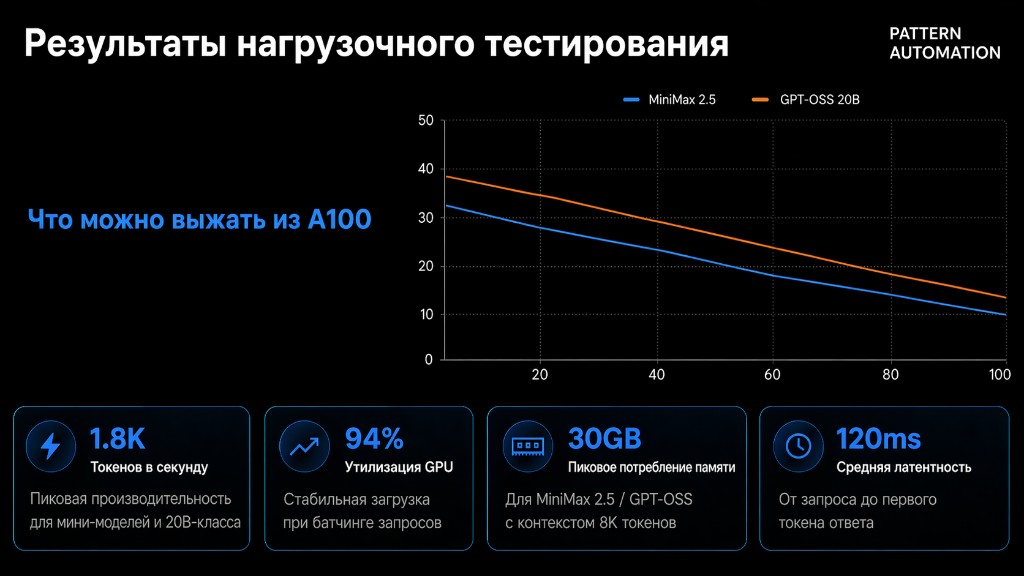
~60Simultaneous requests on 2x NVIDIA A100 80GB
ROI-firstEach project = financial return + KPI
Load test results on an A100 stack: throughput and key GPU, memory, and latency metrics.
Enterprise Loop Stress Test on A100: Use these measurements before selecting final architecture and budget (GPU/LLM/TCO).

Architecture calculator: model “strength”, hardware, costs

Calculations hereapproximate: The total amount may vary significantly depending on the circuit, load and agreements - this is not the limit of accuracy. The most accurate calculations and final estimates are worked out atsecond meetingwith the Pattern Automation team.

Select the level “like an employee” - the calculator will show the class according to the parameters, a guideline for one-time CAPEX for hardware (USD) and adjust the monthly estimate.

Enter your parameters and click Calculate to get a recommended architecture and budget guideline.

How to choose hardware and LLM

  • Load:number of users; request rates and peak windows; volume and number of files per day or per project; typical file size and throughput per day; Peak load on projects per month.
  • Model requirements:size and class, domain specialization, input/output languages, context length; whether advanced mathematics, working in several languages ​​or narrow terminology are needed.
  • Budget: balance CAPEX/OPEX and realistic inference unit economics.
  • Security: on-prem, trusted data center, regulatory compliance.
  • A pilot project and load tests are recommended before large purchases of hardware and contracts - do not postpone testing just for production launch.

Hybrid architecture and risks

  • Hybrid circuit: the platform and data remain on-prem, LLMs are rented by tokens.
  • This approach combines information security for critical data and access to strong models.
  • Risks: rapid obsolescence of technologies, tightening regulations, growth of AI cyber threats.
  • Risk reduction: modular architecture, high information security standards and data isolation by design - the basis for compliance with requirements for confidentiality and personal data (including 152‑FZ and related regulations); The hybrid allows you to keep sensitive data at home and output only the flow allowed by policy to the external model.

8 stages of implementation (briefly)

  • 1. Assessing the impact of AI on business and management synchronization.
  • 2. Readiness analysis: data, processes, capacities, competencies.
  • 3. Formation of a road map, budgets and project teams.
  • 4. Selection of solutions and vendors through pilot scenarios and criteria.
  • 5. Calculation of operating costs and interaction mechanics.
  • 6. Optimization and scaling of successful cases.
  • 7. Transformation of business models and launch of new AI products.
  • 8. Market leadership through systemic AI innovations.

Main conclusion

  • Start with a business goal, not a model choice.
  • Consider the full TCO: integration, training, support, information security (information security: accesses and roles, encryption, audit, policy compliance) and process changes.
  • Pattern Automation's distinctive solution -NEURO OS:a platform for delegating tasks to AI agents and end-to-end automation in one interface (kanban, logs, cost control) - a support for building a managed AI company instead of a set of disparate services.
  • Launch pilots, measure the effect, scale only solutions that have proven ROI.
  • Balance security and economics: critical data in the loop, scale through the cloud.
Why is this important:a significant proportion of corporate AI projects do not achieve their goals precisely because of the lack of a clear business task and KPI contract. The working approach is first the result metrics, then the architecture and phased implementation.
Sources and Research

Materials from McKinsey, Gartner, BCG and related reports - for independent fact checking

McKinsey
Pattern Automation
Research of the Russian financial sector market— Pattern Automation internal report. International analysis of LLM models. Analysis in partnership with PwC (Switzerland and Germany). Analysis in partnership with Salesforce (Germany). Analysis with the participation of Google partners (Germany). Analysis with the participation of Meta partners (Spain). Internal analysis based on current Pattern Automation clients.
Gartner
BCG
Research: SLM, routers, small models
Deloitte, Accenture, others